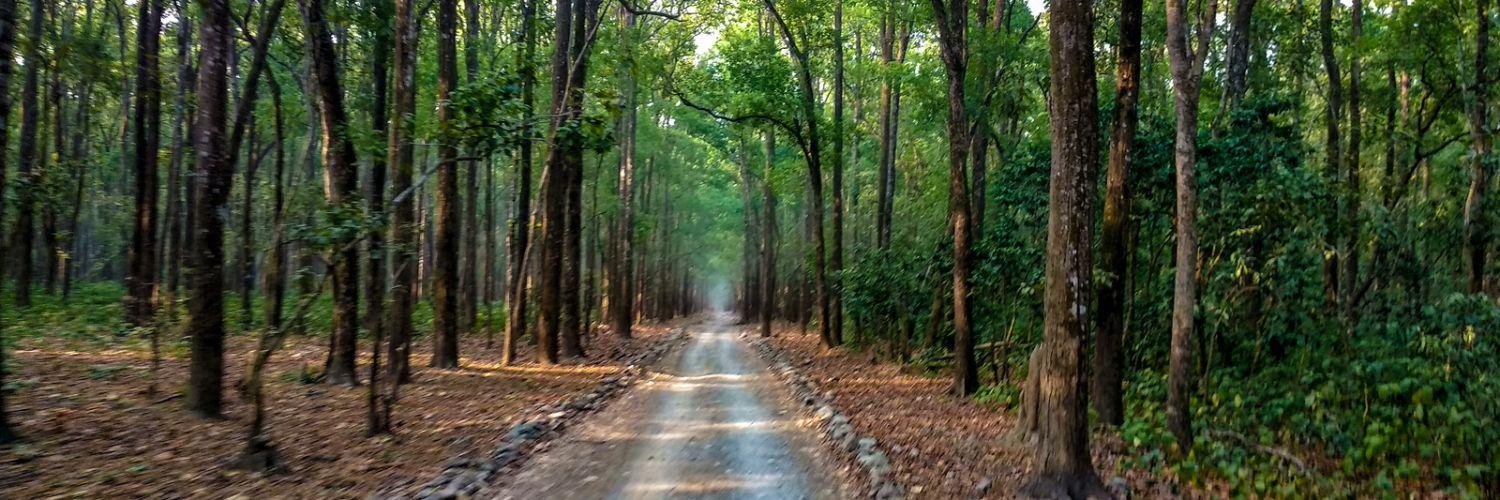
Deep in the forests of central India, the sound of birds, rustling leaves and flowing water creates an atmosphere that feels almost like a storybook.
This is Pench National Park, spread across the southern Satpura landscape of Madhya Pradesh, with the wider Pench Tiger Reserve extending across Madhya Pradesh and Maharashtra.
The forest is famous for its tigers and rich wildlife—but it has another fascinating connection.
Pench is closely associated with the landscapes that inspired Rudyard Kipling’s The Jungle Book.


🌳 A Forest of Teak and Open Grasslands
Pench has a very different appearance from India’s tropical rainforests.
The landscape includes dry deciduous forests, teak trees, bamboo, open grasslands and streams.
During the dry season, many areas become golden and dusty. After the monsoon, the same landscape can turn brilliantly green.
This seasonal transformation is one of the most beautiful features of central India’s forests.
🌊 The River That Gives Pench Its Name
The Pench River flows through the park and is one of the defining features of the landscape.
The river and its surrounding water bodies provide important resources for wildlife.
Animals need water throughout the year, but during the hotter months, water sources become especially important.


🐅 The Tiger’s Territory
Pench is a tiger reserve, and the Bengal tiger remains one of its biggest attractions.
But a tiger reserve is much more than a place where tigers live.
A healthy tiger population depends on a healthy ecosystem containing prey animals, vegetation, water and safe forest corridors.
That is why protecting Pench means protecting an entire web of life.


📖 The Jungle Book Connection
One of Pench’s most interesting stories is its connection with Rudyard Kipling’s The Jungle Book.
The Pench landscape is widely associated with the setting and inspiration behind the famous jungle stories featuring Mowgli and Shere Khan.
The real forest, however, is much more complex than the fictional world.
There are no talking animals or storybook characters here—but there are real tigers, leopards, wolves, wild dogs, deer and hundreds of bird species.


🐆 Leopards in the Forest
Tigers may receive most of the attention, but leopards are another important predator in Pench.
They are elusive and can move through forest areas without being easily noticed.
Their ability to climb trees and adapt to different habitats makes them fascinating members of the ecosystem.
Seeing one during a safari can be a particularly memorable experience.
🐺 Wild Dogs and Other Predators
Pench is also home to dholes, commonly known as Indian wild dogs.
Unlike solitary big cats, dholes are highly social animals and can hunt in groups.
Their presence demonstrates how different predators can coexist within the same forest by using different strategies.


🦌 The Animals That Support the Tigers
A tiger cannot survive without prey.
Pench provides habitat for animals such as:
- 🦌 Spotted deer
- 🦌 Sambar
- 🐂 Gaur
- 🐗 Wild boar
- 🐃 Nilgai
- 🦌 Four-horned antelope
These herbivores depend on the forest’s grasses, leaves and water.
Their populations, in turn, support the reserve’s predators.
🦚 A Paradise for Birdwatchers
Pench is also an excellent destination for people who enjoy birds.
The reserve supports more than 280 bird species, according to Madhya Pradesh Tourism.
Depending on the season, visitors may encounter peafowl, kingfishers, eagles, owls, parakeets and many other birds.


🌧️ Pench During the Monsoon
When the rains arrive, Pench changes dramatically.
The dry forest becomes green.
Streams begin flowing strongly.
Grass grows rapidly.
Bird activity increases.
The entire landscape feels refreshed.
Some core areas of the park have seasonal closures during the monsoon, while permitted buffer areas may offer different experiences. Current access rules should always be checked before planning a visit.


☀️ Summer: When the Forest Reveals Its Secrets
Summer can be extremely hot.
But there is an interesting advantage for wildlife enthusiasts.
As natural water sources become limited, animals often concentrate around available water.
This can sometimes make wildlife easier to observe.
Of course, animals remain wild and sightings are never guaranteed.
The excitement comes from not knowing what will appear around the next bend.
🚙 What Makes a Pench Safari Special?
A safari in Pench isn’t simply about searching for a tiger.
You might begin the morning following tiger tracks.
Then suddenly a herd of deer may raise an alarm.
A peacock may call from the trees.
A langur may start making warning sounds.
Your guide may stop the vehicle and listen carefully.
For a few moments, the entire forest seems to be communicating.


👣 Learning to Read the Jungle
One of the most interesting parts of a safari is learning how guides interpret the forest.
They look for:
Pugmarks
Alarm calls
Broken branches
Fresh animal tracks
Bird behaviour
Movement near water
These small clues can reveal that an animal passed through the area recently.
Even when you don’t see a tiger, the forest is still telling you a story.
🏘️ Forests and Local Communities
The Pench landscape is also connected with local communities living around the protected area.
Tourism can provide opportunities for guides, drivers, accommodation providers and other local businesses.
Responsible tourism can therefore support both conservation and local livelihoods.
But visitors must respect local communities and follow park rules.
🌱 Why Pench Needs Protection
The future of Pench depends on keeping its ecosystem healthy.
That means protecting:
- Forests
- Water sources
- Grasslands
- Wildlife
- Migration routes
- Local ecological connections
A forest is not simply a collection of trees.
It is a living system.


📸 Perfect for Nature Photography
Pench offers plenty of subjects for photographers:
- 🐅 Tigers
- 🐆 Leopards
- 🦌 Deer
- 🐂 Gaur
- 🦚 Peafowl
- 🦅 Birds
- 🌳 Teak forests
- 🌊 River landscapes
- 🌅 Sunrise and sunset
The changing seasons also mean that the same location can look completely different at different times of the year.
🤯 What Makes Pench Special?
Pench combines several experiences in one destination:
🐅 Wildlife
🌳 Forests
🌊 River landscapes
📖 Jungle Book history
🦚 Birdwatching
📸 Photography
🌱 Conservation
That combination makes it one of India’s most interesting forest destinations.
❓ Frequently Asked Questions
Where is Pench National Park?
Pench National Park is in Madhya Pradesh, in the southern Satpura landscape. The wider Pench Tiger Reserve also extends into Maharashtra.
Why is Pench famous?
It is famous for its tigers, rich biodiversity, Pench River and its connection with The Jungle Book.
What animals can be seen in Pench?
Depending on location and season, visitors may see tigers, leopards, dholes, sloth bears, gaur, deer, wild boar and many bird species.
Is Pench connected to The Jungle Book?
Yes. The Pench landscape is widely associated with the inspiration and setting of Rudyard Kipling’s The Jungle Book.
When is Pench open?
The Madhya Pradesh government district information states that Pench National Park generally remains open from October through June, with seasonal conditions and zone-specific rules applying. Always check current official information before travelling.
🌟 Final Thoughts
Pench is a forest where reality feels almost as fascinating as fiction.
The famous stories of Mowgli may have introduced generations of readers to the idea of an Indian jungle.
But the real Pench is even more extraordinary.
Here, the forest is alive with real animals, real rivers, real seasonal changes and real conservation challenges.
A tiger crossing the road.
A herd of gaur disappearing into the trees.
A peacock calling from the grassland.
The Pench River quietly flowing through the landscape.
These moments don’t need a fictional story.
The real jungle already has a story of its own. 🐅🌳📖🇮🇳


🇮🇳 MANA BHARATHAM
Discover the Stories Hidden Across India
From India’s forests and wildlife to hidden destinations, history, culture, heritage and fascinating natural wonders, MANA BHARATHAM brings interesting stories from across the country.
🌐 Website: allpincodes.online
📖 Blog: MANA BHARATHAM
Know India. Explore India. Celebrate India. 🇮🇳
Leave a Reply