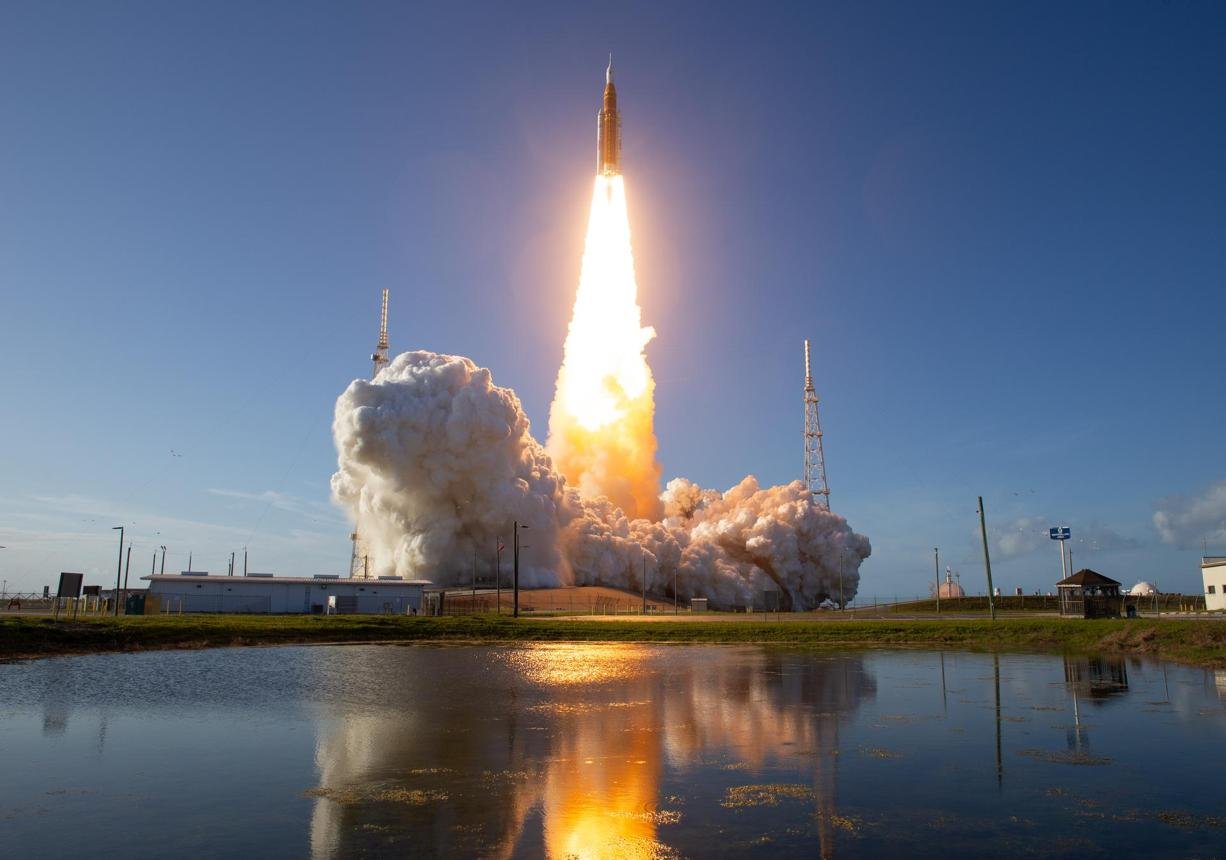
Have you ever looked at a rocket launch and wondered how a giant machine weighing many tonnes can rise from Earth and travel into space?
It looks almost impossible.
A rocket stands vertically on the launch pad. Engines roar. Fire and hot gases shoot downward. Within seconds, the enormous vehicle begins climbing into the sky.
But how does it actually work?
The answer involves Newton’s laws of motion, combustion, fuel, aerodynamics, gravity, computer control and incredibly precise engineering.


🌍 1. Why Is Reaching Space So Difficult?
Earth is constantly pulling everything toward its surface through gravity.
A rocket must overcome gravity while also dealing with Earth’s atmosphere.
The higher it goes, the thinner the atmosphere becomes, but the rocket still needs enormous energy to accelerate.
Space is commonly considered to begin around 100 kilometres above Earth’s surface, although the atmosphere doesn’t suddenly end at one particular height.
So a rocket isn’t simply trying to “go up.”
It must gain enormous speed as well.
For a spacecraft to enter a stable low Earth orbit, it typically needs to reach roughly 7.8 km/s horizontally, although the exact launch velocity depends on the orbit and mission.
That is more than 28,000 km/h.


🔥 2. The Basic Secret: Push Gas Down, Rocket Goes Up
The fundamental principle behind rocket propulsion comes from Newton’s Third Law of Motion:
For every action, there is an equal and opposite reaction.
A rocket burns propellant and produces extremely hot, high-pressure gases.
Those gases are accelerated through the rocket engine nozzle and expelled downward at very high speed.
The rocket receives an opposing force upward.
🔥 Hot gases go down → 🚀 Rocket moves up
This is called thrust.
And unlike an aircraft engine, a rocket carries its own oxidizer, so it can operate even where there is essentially no atmospheric oxygen.


⛽ 3. What Is Rocket Fuel?
People often say “rocket fuel,” but a rocket propulsion system generally uses propellants, which can include both fuel and oxidizer.
For example, some modern liquid rocket engines use:
- 🧪 Liquid hydrogen
- 🧪 Liquid oxygen
- 🧪 Kerosene-type fuels
- 🧪 Methane
- 🧪 Other specialized propellants
Different rockets use different combinations.
The choice depends on factors such as efficiency, storage requirements, engine design and mission objectives.


🔥 Why Does the Rocket Need So Much Propellant?
Because rockets must accelerate not only themselves but also the propellant they are carrying.
This creates a major engineering challenge.
As propellant is consumed, the rocket becomes lighter.
That is one reason rockets can accelerate more effectively later in flight.
⚙️ 4. How Does a Rocket Engine Work?
A simplified liquid rocket engine works like this:
Step 1 — Propellants are stored
Fuel and oxidizer are kept in tanks.
Step 2 — They are pumped into the engine
Powerful turbopumps or other feed systems move the propellants toward the combustion chamber.
Step 3 — Combustion occurs
The propellants react inside the combustion chamber, producing extremely hot, high-pressure gas.
Step 4 — Gas enters the nozzle
The nozzle converts pressure and thermal energy into a very fast exhaust jet.
Step 5 — Thrust is produced
The high-speed exhaust produces the force that accelerates the rocket.


🚀 5. Why Do Rockets Have Multiple Stages?
One of the most fascinating features of many rockets is staging.
A rocket can contain two, three or more stages.
Each stage has its own engines and propellant.
Once a stage has used most of its propellant, it can be separated and discarded.
This reduces the mass that the remaining rocket has to accelerate.


Imagine climbing a mountain while carrying a heavy backpack.
If you could safely remove the backpack partway through the journey, climbing would become easier.
Rocket staging works on a similar principle.
🌬️ 6. What Happens During the First Few Seconds?
At launch, the rocket must overcome its own weight.
The engines generate enormous thrust.
When thrust becomes greater than the force of gravity acting on the rocket, the vehicle begins accelerating upward.
At first, the rocket moves relatively slowly compared with its later speed.
Then its velocity increases rapidly.


🧭 7. Why Doesn’t the Rocket Fly Straight Up?
This is an important point.
A rocket doesn’t simply fly vertically all the way into space.
After launch, it gradually pitches over.
This maneuver helps it build horizontal velocity.
Why?
Because reaching orbit isn’t mainly about getting high above Earth.
It is about moving sideways fast enough to continuously fall around Earth.
That’s what an orbit essentially is.


🌎 8. What Does “Orbit” Actually Mean?
Imagine throwing a ball.
It falls back to Earth.
Now imagine throwing it much faster.
It travels farther before falling.
If you could throw it fast enough, Earth’s curved surface would fall away beneath it at roughly the same rate that the object falls toward Earth.
The object would keep going around the planet.
That is the basic idea of an orbit.
A spacecraft in orbit is still affected by gravity.
It is essentially in continuous free fall around Earth.


🛰️ 9. How Does a Rocket Put a Satellite Into Orbit?
Suppose a rocket is carrying a communications satellite.
The rocket climbs through the atmosphere and accelerates.
The first stage may separate.
Another stage continues the journey.
Eventually, the rocket reaches the required altitude and velocity.
Then the upper stage performs the final maneuver.
The satellite is released.
At that point, the satellite continues travelling around Earth in its planned orbit.


🧠 10. How Does the Rocket Know Where to Go?
Modern rockets use sophisticated guidance, navigation and control systems.
Computers continuously process information from sensors.
These systems can measure things such as:
- 📐 Orientation
- 🚀 Acceleration
- 🧭 Direction
- 📍 Position
- ⏱️ Flight time
- 🔄 Rotation
The rocket’s computers use this information to control its flight.
Small changes in engine direction or control surfaces can alter the vehicle’s trajectory.


🔄 11. How Can a Rocket Turn?
The engines don’t always point perfectly straight.
In many rockets, engines can be gimbaled, meaning their direction can be adjusted.
Changing the direction of the thrust changes the rocket’s attitude and trajectory.
Some spacecraft also use small control thrusters for orientation.
In simple terms:
Change thrust direction → change rocket direction.
🌡️ 12. What Happens When a Rocket Leaves the Atmosphere?
As the rocket climbs, atmospheric pressure decreases.
Eventually, the surrounding air becomes extremely thin.
But reaching space doesn’t mean the journey is finished.
The rocket still needs to reach the required velocity for its mission.
For an orbital mission, speed is more important than simply altitude.
That is why rockets continue accelerating even after they are already far above most of the atmosphere.
🔥 13. Why Does a Rocket Produce So Much Fire?
The bright plume comes from the hot exhaust produced by the engine.
The appearance of the exhaust depends on the propellant combination, engine design and surrounding pressure.
Near the ground, the exhaust interacts strongly with the atmosphere.
Higher up, the exhaust expands differently because the surrounding pressure is much lower.


🧱 14. What Is a Rocket Made Of?
A launch vehicle contains many different systems.
Main structures include:
- 🛢️ Propellant tanks
- 🔥 Engines
- 🧠 Flight computers
- 🛰️ Payload section
- ⚡ Electrical systems
- 📡 Communication systems
- 🧭 Guidance systems
- 🛡️ Thermal protection where required
- 🔩 Structural components
Every kilogram matters.
Engineers constantly try to make structures strong without making them unnecessarily heavy.
🛰️ 15. What Can Rockets Carry?
Rockets can carry many different payloads.
Satellites
For communication, navigation, Earth observation and scientific research.
Spacecraft
For carrying astronauts or supplies.
Scientific instruments
For studying Earth, the Sun, planets and distant objects.
Space telescopes
For observing the universe.


🇮🇳 16. How Does India Launch Rockets?
India has developed its own family of launch vehicles through ISRO and India’s broader space ecosystem.
The PSLV has been widely used for launching satellites, while the LVM3 is a larger launch vehicle capable of carrying heavier payloads to orbit.
India has also developed the GSLV for missions requiring different orbital capabilities.


India’s primary spaceport, Satish Dhawan Space Centre at Sriharikota, is a major launch site for Indian orbital missions.
👨🚀 17. What Happens When Humans Travel on a Rocket?
When a rocket carries people, the engineering requirements become even more demanding.
The spacecraft needs systems for:
- 🫁 Oxygen
- 🌡️ Temperature control
- 💧 Water
- 🧑🚀 Life support
- 📡 Communication
- 🛡️ Emergency systems
- 🪂 Safe return where applicable
Astronauts also experience significant acceleration during launch.
That is why human-rated spacecraft undergo extensive testing and safety procedures.


♻️ 18. Are Rockets Reusable?
Some modern launch vehicles are designed to reuse certain stages.
Instead of throwing away the entire launch vehicle, a reusable booster can return and land for refurbishment and another flight.
This can potentially reduce the cost and resources required for future launches, although refurbishment and operations still involve significant expense.


🤯 10 Amazing Rocket Facts
1. 🚀 Rockets carry their oxidizer
They don’t depend on atmospheric oxygen to burn their propellant.
2. 🌍 Orbit requires enormous speed
Getting high is not enough—you need sufficient horizontal velocity.
3. 🔥 Rocket engines produce extreme temperatures
Combustion chambers and exhaust systems must survive very harsh conditions.
4. 🧱 Every kilogram matters
Reducing unnecessary mass can significantly improve performance.
5. 🛰️ Rockets can launch satellites
Modern communications, navigation and Earth-observation systems depend heavily on orbital launch vehicles.
6. 🧠 Computers guide the rocket
Modern launch vehicles rely heavily on sophisticated guidance and control systems.
7. 🚀 Many rockets use stages
Discarding empty stages reduces the mass carried by the remaining vehicle.
8. 🌌 Space isn’t the end of the journey
After reaching orbit, spacecraft may need additional maneuvers to reach their final destination.
9. ♻️ Some rockets can be reused
Reusable launch technology is changing the economics of spaceflight.
10. 🇮🇳 India has its own orbital launch vehicles
India has developed launch systems including PSLV, GSLV and LVM3.
🌌 What Happens After the Rocket Reaches Space?
Once the payload has been successfully deployed, the mission continues according to its purpose.
A satellite might begin operating.
A spacecraft might travel toward another orbit.
A crewed spacecraft might rendezvous with a space station.
A scientific probe might begin a journey toward another planet.
So the rocket is often only the first step of a much bigger space mission.


🧪 Rocket Science Is More Than Just Fire
When we see a launch, the flames and sound are spectacular.
But behind those few minutes are years of work.
Engineers must calculate:
How much propellant is required?
How strong should the structure be?
When should each stage separate?
What trajectory should the rocket follow?
How should the spacecraft be protected?
What happens if something goes wrong?
Every answer requires physics, mathematics, computer science and engineering.
That’s why rocket science is considered one of the most challenging fields of engineering.
🌟 Final Thoughts
A rocket doesn’t reach space simply because it has a powerful engine.
It reaches space because thousands of systems work together.
🔥 Propellant creates energy.
🚀 Engines create thrust.
🧭 Computers control the flight.
⚙️ Stages reduce unnecessary mass.
🌍 Physics determines the trajectory.
🛰️ The payload performs the mission.
And behind everything are engineers and scientists who spend years designing, testing and improving these machines.
The next time you watch a rocket launch, remember:
You’re not just watching a machine fly into the sky.
You’re watching physics, mathematics and human engineering leave Earth. 🚀🌍✨


🇮🇳 MANA BHARATHAM
Stories, Facts & Wonders From India
🌐 Website: allpincodes.online
📖 Blog: MANA BHARATHAM
Know India. Explore India. Celebrate India. 🇮🇳
Leave a Reply