India is one of the world’s most diverse countries.
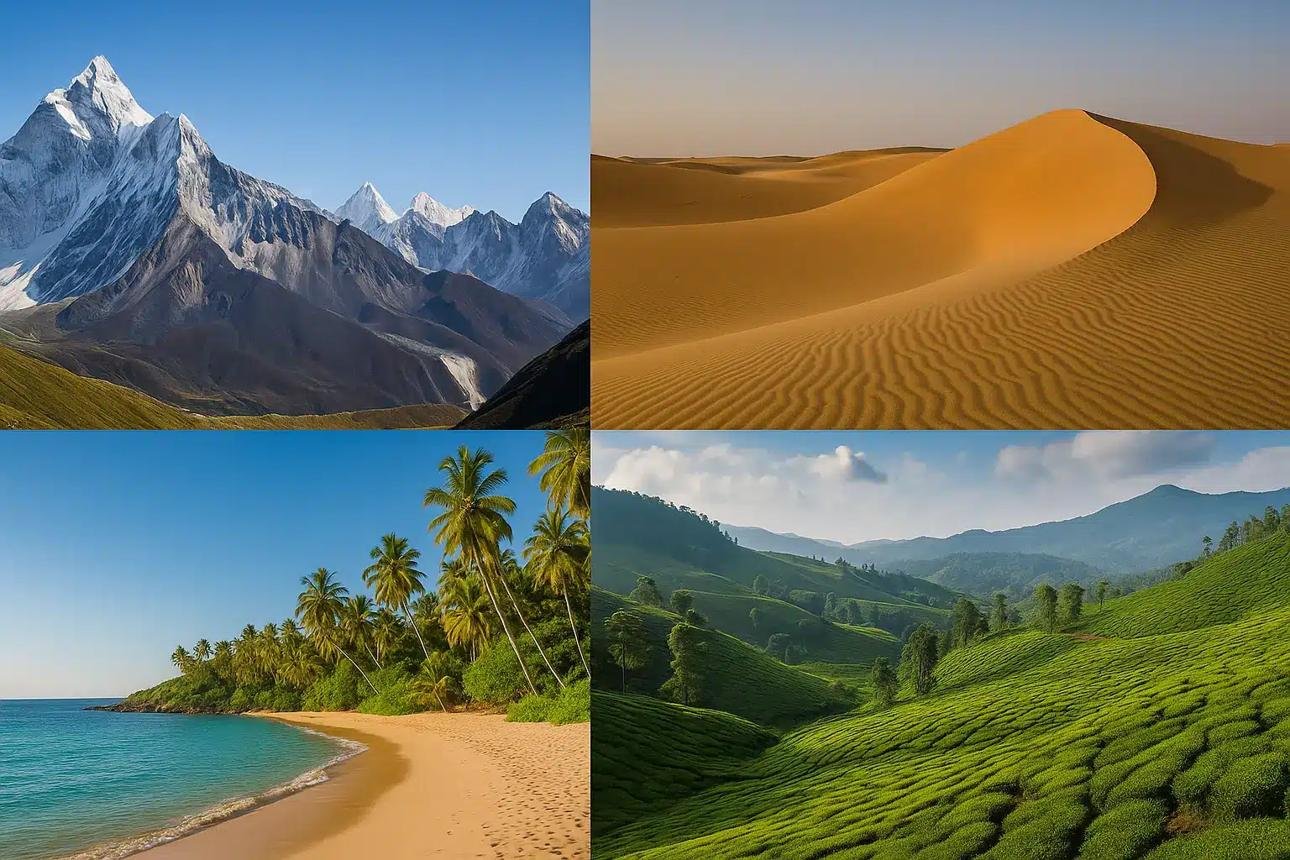
From the snow-covered Himalayas to tropical islands, from ancient traditions to modern technology, India contains an extraordinary variety of landscapes, languages, cultures and lifestyles.
But what exactly makes India different?
Let’s explore 10 fascinating features that make India stand out in the world.


🏔️ 1. India Has Extraordinary Geographic Diversity
India’s geography changes dramatically from one region to another.
In the north are the Himalayas, among the world’s highest mountain ranges.
Further south are vast plains, forests, plateaus and deserts.
India also has long coastlines and island groups in the Arabian Sea and Bay of Bengal.


Within one country, you can find:
- 🏔️ Snow-covered mountains
- 🏜️ Desert landscapes
- 🌴 Tropical regions
- 🌊 Long coastlines
- 🌳 Dense forests
- 🏝️ Islands
- 🌾 Vast agricultural plains
This geographical variety is one of India’s most remarkable characteristics.
🗣️ 2. India Is Home to Extraordinary Linguistic Diversity
India isn’t a country where everyone speaks one language.
The Constitution of India recognizes 22 languages in its Eighth Schedule, while the country has many more languages and varieties spoken by its population.
Major languages include:
- Hindi
- Bengali
- Telugu
- Marathi
- Tamil
- Gujarati
- Kannada
- Malayalam
- Punjabi
- Odia
- Assamese
And many others.


One interesting feature is that India’s languages can use completely different writing systems.
For example:
தமிழ் — தமிழ் script
తెలుగు — Telugu script
বাংলা — Bengali script
ગુજરાતી — Gujarati script
Yet all of these languages belong to the cultural and linguistic landscape of the same country.
🕉️ 3. Several Major Religions Have Their Roots in India
India has been the birthplace of several major religious and philosophical traditions.
These include:
🕉️ Hinduism
☸️ Buddhism
🪷 Jainism
🪯 Sikhism
India is also home to large communities following Christianity, Islam, Judaism, Zoroastrianism and other traditions.


This creates a remarkably diverse religious landscape.
In many Indian cities, different religious places can be found within a relatively small area.
🧘 4. Yoga Became a Global Phenomenon
Yoga has historical roots in the Indian subcontinent and developed through centuries of philosophical and physical traditions.
Today, yoga is practiced across the world.


What began as part of India’s philosophical and spiritual traditions has become a global practice associated with physical exercise, breathing and meditation.
The United Nations designated June 21 as International Day of Yoga in 2014.
That is a remarkable example of an Indian tradition becoming a worldwide phenomenon.
🍛 5. Indian Food Changes Dramatically From Region to Region
Ask someone about Indian food and they might immediately think of curry, naan or biryani.
But Indian cuisine is much more diverse than that.
Food traditions vary enormously between regions.


For example:
South India
Rice, dosa, idli, sambar and many coconut-based dishes.
North India
Wheat-based breads, dals, paneer dishes and different styles of curries.
West India
Distinct Gujarati, Maharashtrian, Goan and Rajasthani food traditions.
East India
Rice, fish and unique sweets are important in many regional cuisines.
Northeast India
Food traditions differ considerably from those found elsewhere in the country.
So there isn’t really one single thing called “Indian food.”
There are hundreds of regional food traditions.
🐅 6. India Is One of the World’s Most Important Tiger Countries
India is home to a significant proportion of the world’s wild tiger population.
The country has invested heavily in tiger conservation through Project Tiger, launched in 1973.


India’s tiger reserves protect important habitats across different landscapes.
These include forests, grasslands and mangrove ecosystems.
The Royal Bengal tiger has become one of the most recognizable symbols of India’s wildlife.
🌧️ 7. India Has Extremely Different Rainfall Patterns
India’s climate varies enormously.
Some areas receive enormous amounts of rainfall, while other regions are extremely dry.
The northeastern part of India includes places famous for exceptionally heavy rainfall.


Meanwhile, the Thar Desert in western India has a completely different environment.
This contrast is remarkable:
🌧️ Extremely wet regions
versus
🏜️ Extremely dry regions
within the same country.
The Indian monsoon plays a major role in shaping India’s climate, agriculture and economy.
🚆 8. India’s Railway System Is Enormous
Indian Railways is one of the world’s largest railway systems.
Millions of passengers use the railway network, which connects cities, towns and rural areas across the country.


A railway journey in India can take you through completely different landscapes.
You might start near the Himalayas and eventually travel through plains, forests, cities and coastal regions.
For many Indians, trains are not merely transportation.
They are part of everyday life.
🏛️ 9. India Has Both Ancient Heritage and Modern Technology
One of India’s most interesting contrasts is the coexistence of ancient traditions and modern science.
India has archaeological sites, ancient literature, historic temples and traditional knowledge systems.
At the same time, India has a major modern technology and space sector.


India’s space programme has developed launch vehicles, satellites and planetary missions.
For example, India’s Chandrayaan-3 mission successfully landed near the Moon’s south polar region in 2023.
That creates a fascinating contrast:
Ancient heritage on Earth + spacecraft exploring the Moon.
🎉 10. India’s Festivals Can Look Completely Different From One State to Another
India has an enormous number of festivals and celebrations.
Some are celebrated across large parts of the country, while others are strongly associated with particular regions or communities.
Examples include:
🪔 Diwali
🎨 Holi
🌾 Pongal
🌸 Onam
🛕 Durga Puja
🪷 Baisakhi
🐘 Ganesh Chaturthi
And many regional celebrations.
The traditions, clothing, food, music and rituals can change dramatically from one state to another.
🤯 India Is Almost Like Many Worlds in One Country
Think about the differences.
You can travel from:
🏔️ Himalayan mountains
to
🏜️ Rajasthan’s desert
then to
🌴 Kerala’s tropical landscapes
and finally to
🏝️ the Andaman Islands.


The landscape changes.
The food changes.
The language changes.
The clothing changes.
The architecture changes.
The festivals change.
And yet all of these places are part of one country.
🌍 Is India Really “Different From Every Other Country”?
Every country has its own unique characteristics, so it would be inaccurate to say India is completely unlike every other nation.
What makes India particularly remarkable is the scale and combination of its diversity.
It combines:
- 🗣️ Huge linguistic diversity
- 🕉️ Multiple major religious traditions
- 🏔️ Dramatically different landscapes
- 🍛 Hundreds of regional cuisines
- 🐅 Major biodiversity
- 🎉 Diverse cultural traditions
- 🚆 A vast railway system
- 🚀 A modern space programme
- 🏛️ Ancient historical heritage
That combination gives India a very distinctive identity.
🇮🇳 10 Quick Facts About What Makes India Special
1. India has 22 constitutionally recognized languages.
2. The Himalayas form India’s northern mountain frontier.
3. India is home to several religions that originated in the subcontinent.
4. Yoga has become a worldwide practice.
5. Indian cuisine varies dramatically between regions.
6. India is one of the world’s most important countries for wild tiger conservation.
7. India contains both extremely wet and extremely dry regions.
8. Indian Railways operates one of the world’s largest railway networks.
9. India combines ancient cultural heritage with modern space technology.
10. Indian festivals and traditions vary enormously across regions.
🌟 Final Thoughts
India cannot be described by one language.
It cannot be described by one food.
It cannot be described by one religion.
It cannot be described by one landscape.
And it certainly cannot be described by one tradition.
India is a country where mountains meet oceans, deserts meet forests, ancient traditions meet modern technology, and hundreds of cultures share one national identity.
That is perhaps the most fascinating thing about India.
🇮🇳 India’s greatest difference is not one single feature—it is the extraordinary diversity that exists together within one country.


🇮🇳 MANA BHARATHAM
Stories, Facts & Wonders From India
🌐 Website: allpincodes.online
📖 Blog: MANA BHARATHAM
Know India. Explore India. Celebrate India. 🇮🇳
Leave a Reply