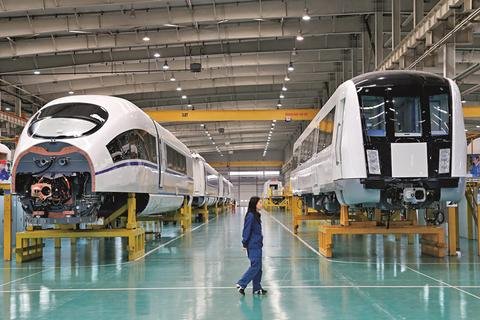
Have you ever watched a huge train rushing through a railway station and wondered:
How is something this massive actually built?
A modern train is not made in one place by one machine.
It is the result of thousands of engineering decisions, powerful machines, skilled workers, electronics, computer systems and extremely precise testing.
From a simple sheet of steel to a train weighing many tonnes, the manufacturing process is a fascinating journey.


🏭 1. Everything Starts With a Design
Before a single piece of metal is cut, engineers design the train.
They decide:
- 🚆 How long the train should be
- ⚡ What type of power it will use
- 🛞 Wheel and bogie design
- 🧍 Passenger capacity
- 🌬️ Aerodynamics
- 🛑 Braking system
- 💺 Interior arrangement
- 🔌 Electrical systems
- 🛡️ Safety requirements
Modern trains are usually designed using advanced computer-aided engineering software.
Engineers can create a detailed digital model before manufacturing begins.


🧠 Why Is Design So Important?
A train has to carry hundreds or sometimes thousands of people while travelling at high speed.
It must remain stable.
It must stop safely.
It must withstand vibration.
And it must operate in different weather conditions.
That means even a small component has an important job.
🔩 2. Steel Becomes the Train Body
One of the most recognizable parts of a train is its outer body.
Large sheets and structural sections made from materials such as steel or aluminium alloys are cut and shaped according to engineering specifications.
Manufacturers use powerful industrial equipment to cut, bend and form these components.


The individual sections are then assembled into a strong car body.
It is a little like building a giant metal structure—but with extremely precise measurements.
🔥 3. Welding Holds the Structure Together
Once the metal sections are positioned correctly, they are joined together.
Welding is one of the most important manufacturing processes.
Industrial welding equipment creates strong joints between metal components.
In modern factories, robots may perform repetitive welding operations, while skilled technicians inspect the results.


The quality of these joints is critical.
A train body has to withstand years of vibration and repeated journeys.
🛞 4. The Bogie: The Train’s Hidden Hero
Now comes one of the most important parts that passengers rarely notice.
The bogie is the wheel-and-suspension assembly located underneath a railway vehicle.
It supports the vehicle and helps it move smoothly along the track.


A bogie contains components such as:
- 🛞 Wheels
- ⚙️ Axles
- 🔧 Bearings
- 🌀 Suspension
- 🛑 Braking components
- 🔩 Structural frames
Without properly designed bogies, a train could not safely travel at speed.
⚙️ 5. Wheels Are Manufactured With Extreme Precision
Train wheels may look simple.
They are not.
Their dimensions and profiles have to be manufactured very accurately.
The wheel’s shape affects how it interacts with the railway track.


Manufacturers use machining processes to achieve the required dimensions.
Wheels are also inspected for defects before being used.
Even a tiny manufacturing problem can become a serious safety issue.
⚡ 6. Installing the Train’s Power System
A train needs an enormous amount of energy to move.
Depending on the type of train, the power can come from:
⚡ Overhead electrical lines
🔋 Batteries
⛽ Diesel engines
or combinations of different technologies.
Electric trains use electrical equipment to convert and control the incoming power.


🔌 What Actually Makes an Electric Train Move?
Electricity doesn’t simply go directly to the wheels.
It passes through several systems that control voltage, current and motor operation.
Electric traction motors then convert electrical energy into mechanical motion.
Electrical energy → Motor → Mechanical rotation → Wheels → Train moves 🚆
🛑 7. Brakes Are Just as Important as Motors
Making a train move is only half the challenge.
Engineers must also make sure it can stop safely.
Modern trains use sophisticated braking systems.
Depending on the train, these can include:
- Air brakes
- Disc brakes
- Regenerative braking
- Electronic brake controls


Some electric trains can use regenerative braking, where energy generated during braking can be returned to the electrical system or otherwise managed for improved efficiency.
💺 8. The Empty Metal Shell Becomes a Passenger Train
Once the major mechanical systems are installed, the interior work begins.
Workers install:
- 💺 Seats
- 🚪 Doors
- 💡 Lighting
- ❄️ Air-conditioning systems
- 🔊 Public-address equipment
- 🖥️ Passenger information displays
- 🚻 Toilets where applicable
- 🔌 Electrical outlets and other equipment


This is when the train starts looking like the vehicle passengers recognize.
🎨 9. Painting and Exterior Finishing
The outside of the train receives its final surface treatment.
Depending on the manufacturer and train type, this can involve surface preparation, protective coatings and paint or other finishing systems.


The paint is not only about appearance.
Coatings can also help protect the body from environmental exposure and corrosion.
🧪 10. Testing the Train
This is one of the most important stages.
A newly manufactured train cannot simply leave the factory and immediately start carrying passengers.
It must undergo extensive testing.
Engineers test systems such as:
🚆 Movement
Does the train move correctly?
🛑 Braking
Can it stop as expected?
🚪 Doors
Do the doors open, close and lock correctly?
⚡ Electrical systems
Are the electrical systems operating safely?
🌡️ Climate control
Can heating and cooling systems maintain the required conditions?
📡 Communication
Do communication and passenger information systems work correctly?


🏎️ 11. High-Speed Testing
Some trains are tested at increasing speeds under controlled conditions.
Engineers monitor:
- Vibration
- Wheel behaviour
- Braking performance
- Electrical systems
- Noise
- Stability
- Temperature
- Software and control systems
The goal is to make sure the train behaves predictably under different operating conditions.
🧑🔧 12. Humans Still Play a Huge Role
Modern factories can contain robots and highly automated equipment.
But people remain essential.
Engineers, technicians, welders, electricians, inspectors, software specialists and quality-control teams all contribute to the final train.


A modern train is therefore a combination of:
Human skill + engineering + automation + science.
🤯 How Many Parts Does a Train Have?
A modern train contains an enormous number of individual components.
Think about everything that has to work together:
🛞 Wheels
⚙️ Motors
🔌 Cables
💡 Lights
🚪 Doors
🛑 Brakes
🧠 Computers
📡 Sensors
❄️ Air-conditioning
💺 Seats
🔊 Speakers
and many more.
One train is essentially a moving engineering system.
🧠 Trains Are Becoming Smarter
Modern trains increasingly use sensors and computer systems to monitor their condition.
Sensors can collect information about things such as:
- Temperature
- Vibration
- Speed
- Brake condition
- Motor performance
- Door operation
This information can help maintenance teams identify potential problems before they become major failures.


🌱 What About Future Trains?
The trains of the future may become even more efficient.
Engineers are working on technologies involving:
🔋 Battery-electric trains
⚡ More efficient traction systems
🤖 Automated operation
🧠 Artificial intelligence and advanced monitoring
🌱 Lightweight materials
♻️ More energy-efficient systems
Some railways are also exploring hydrogen-powered trains for particular applications.
The basic goal is simple:
Move more people while using less energy and producing fewer emissions.
🇮🇳 What About Train Manufacturing in India?
India has a major railway manufacturing ecosystem.
Different facilities and companies manufacture railway coaches, locomotives, trainsets, components and related equipment.
Indian Railways has also developed modern train technologies and manufacturing capabilities over the years.


Modern Indian train manufacturing increasingly combines traditional railway engineering with electronics, software and advanced manufacturing techniques.
🤔 Why Does a Train Take So Much Engineering?
Because a train isn’t just a large vehicle.
It is a machine designed to safely move huge numbers of people.
Imagine a train travelling at high speed while:
Hundreds of wheels rotate.
Motors produce enormous force.
Brakes must respond correctly.
Doors must remain secure.
Computers continuously monitor systems.
Passengers expect a smooth ride.
Everything has to work together.
That is why building a train is an engineering masterpiece.
🚆 From a Piece of Metal to a Moving Giant
The next time you see a train entering a station, don’t just look at it as a vehicle.
Think about its journey.
First came the design.
Then the metal.
Then cutting and forming.
Then welding.
Then wheels and bogies.
Then motors and electrical systems.
Then brakes.
Then seats and interiors.
Then paint.
Then hundreds of tests.
Finally…
🚆 The train is ready to travel.
A train that may look simple from the outside is actually the result of engineering, physics, mathematics, electronics, manufacturing and thousands of human decisions.
And perhaps the most amazing part is this:
That enormous machine can carry hundreds of people smoothly across hundreds or thousands of kilometres.
That is the science behind the train. 🚆⚙️🌍


🇮🇳 MANA BHARATHAM
Stories, Facts & Wonders From India
🌐 Website: allpincodes.online
📖 Blog: MANA BHARATHAM
Know India. Explore India. Celebrate India. 🇮🇳
Leave a Reply