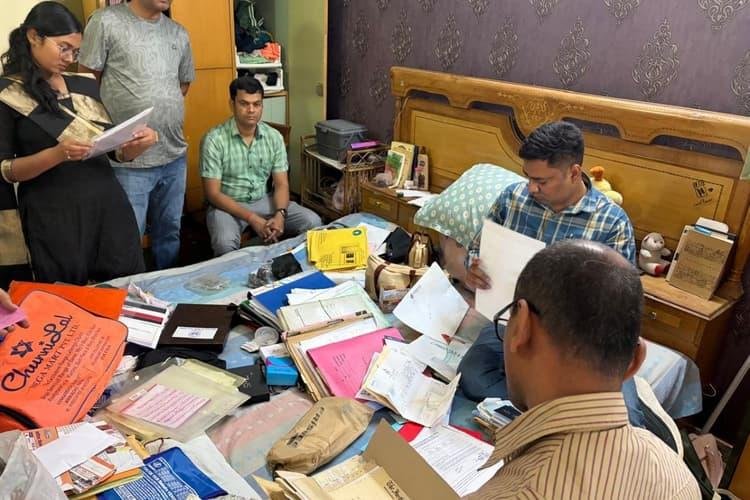
In India, whenever the Income Tax Department, Enforcement Directorate (ED), Central Bureau of Investigation (CBI), or Anti-Corruption Bureau (ACB) conducts a search at the home, office or business premises of a politician, government official, businessman or other prominent person, it immediately becomes major news.
People often ask:
- How many raids have taken place in India?
- Why are these searches conducted?
- What do investigators look for?
- How much money or property is seized?
- Does a raid mean the person is guilty?
- What happens after a search?
The answers are more complicated than a television headline suggests.
🔎 Is There One Official Number for All Raids in India?
No.
There is no single official database giving the total number of ACB + Income Tax + ED + CBI raids in India from 1947 to 2026.
This is because the agencies work under different laws and maintain different types of records.
For example:
- Income Tax records search and seizure operations.
- ED records PMLA, FEMA and FEOA investigations and actions.
- CBI records cases and individual search operations.
- ACBs operate primarily at the state level, so their figures are not maintained as one nationwide ACB total.
Also, a case, search, arrest, attachment and conviction are different things.
Therefore, publishing a made-up figure such as “India has witnessed 20,000 raids” would be misleading.


🏦 Income Tax Department Searches
The Income Tax Department conducts searches when it has legal grounds to investigate matters such as:
- Undisclosed income
- Tax evasion
- Unaccounted assets
- Hidden financial transactions
- Suspected manipulation of accounts
- Other tax-related irregularities
During a lawful search, investigators may examine or seize relevant material such as:
- Cash
- Jewellery
- Property documents
- Account books
- Invoices
- Agreements
- Computers
- Hard drives
- Mobile phones
- Digital records
India’s tax framework changed in 2026 with the Income-tax Act, 2025. The Income Tax Department’s official material explains the new framework applicable from April 1, 2026.
📊 How Large Can Income Tax Search Operations Be?
There is no single 1947–2026 total, but historical government data shows that Income Tax search operations have sometimes been conducted on a large scale.
For example, official government data for earlier financial years recorded:
| Financial Year | Search & Seizure Groups |
|---|---|
| 2013–14 | 569 |
| 2014–15 | 545 |
| 2015–16 | 445 |
These figures refer to search groups, not necessarily individual people.
One search operation may cover several premises belonging to the same business group or connected persons.
💰 Does Finding Cash Automatically Mean Black Money?
No.
This is one of the most important points to understand.
If cash is found during a search, investigators still have to determine:
- Where did the cash come from?
- Was it recorded in the accounts?
- Was it disclosed for tax purposes?
- Is there supporting documentation?
- Is there a legitimate business explanation?
Therefore:
Cash found ≠ Automatically illegal money
The legal status of the money depends on the evidence and the subsequent proceedings.
The same principle applies to jewellery, property and other assets.
🚔 What Is an ACB Raid?
ACB stands for Anti-Corruption Bureau.
State-level anti-corruption agencies investigate allegations involving public servants, particularly matters such as:
- Bribery
- Illegal gratification
- Corruption
- Disproportionate assets
India does not have one single nationwide ACB operating in exactly the same manner across every state.
Different states have their own anti-corruption or vigilance structures.
Therefore, there is no reliable single figure representing all ACB raids in India since 1947.
💵 How Does an ACB Trap Case Work?
Suppose a government employee is alleged to have demanded money for performing an official duty.
A complaint may be made to the anti-corruption authorities.
After following the required legal procedures, investigators may arrange a trap operation to gather evidence of the alleged bribe transaction.
If evidence is obtained, a criminal case may follow.
But an important distinction remains:
A trap or arrest is not the same as a final conviction.
The case still has to go through the legal process.
🏠 What Is a Disproportionate Assets Case?
Another important category in anti-corruption investigations is a Disproportionate Assets (DA) case.
In simple terms, investigators may examine whether a public servant’s assets and expenditure are disproportionate to their known lawful sources of income.
For example, investigators may examine:
Income + legitimate financial resources
against
Assets + expenditure during the relevant period
But such calculations can be complicated.
Investigators may also need to consider:
- Previous assets
- Loans
- Inherited property
- Family income
- Agricultural income
- Legitimate investments
- Other lawful sources
Therefore, simply saying that someone owns “very expensive property” does not by itself prove corruption.
🕵️ What Does the Enforcement Directorate Do?
The Enforcement Directorate (ED) is India’s major financial investigation agency.
Among other responsibilities, it investigates cases under:
PMLA — Prevention of Money Laundering Act
and
FEMA — Foreign Exchange Management Act
ED investigations can involve matters such as:
- Money laundering
- Proceeds of crime
- Certain foreign-exchange violations
- Financial transactions connected to alleged criminal activity
📈 ED’s Official Numbers Up to March 31, 2026
The ED’s official statistics provide a useful picture of the scale of its work.
As of 31 March 2026, the ED reported:
- 8,851 ECIRs recorded under PMLA
- 3,501 provisional attachment orders
- ₹2,36,016.61 crore in provisional attachment orders
- 1,187 persons arrested
- 2,396 prosecution complaints filed
- 466 cases in which charges had been framed
- 60 completed PMLA trials
- 56 trial cases resulting in conviction
However, there is an extremely important point:
8,851 ECIRs does NOT mean 8,851 raids.
An ECIR is an investigation record; it should not be presented as a search count.
💼 ED and Property Attachment
During a money-laundering investigation, property believed to be connected to proceeds of crime can be subject to provisional attachment under the applicable legal process.
But:
Attachment is not the same as final confiscation.
The legal process continues through the appropriate authorities and courts.
This distinction is important when reporting financial investigations.
🏛️ What Does the CBI Do?
The Central Bureau of Investigation (CBI) investigates a range of cases falling within its jurisdiction, including certain:
- Corruption cases
- Bribery cases
- Bank frauds
- Major economic offences
- Criminal conspiracies
- Court-directed investigations
CBI searches can involve homes, offices, companies and other premises connected to an investigation.
🚨 Recent CBI Search Examples
The scale of CBI searches can vary enormously depending on the case.
April 2026 — Builder-related investigations
In April 2026, CBI conducted searches at 77 locations across eight States/UTs in connection with 22 cases involving alleged builder-financial institution nexus. The searches reportedly resulted in seizure of documents, digital devices and other material for examination.
May 2026 — Bank fraud cases
In another operation, CBI searched seven premises in Mumbai and Ahmedabad in two bank-fraud cases involving an alleged combined loss of ₹119.03 crore to public-sector banks.
July 2026 — Bank fraud investigations
On July 4, 2026, CBI conducted coordinated searches in two bank-fraud cases involving alleged losses exceeding ₹231 crore.
These examples demonstrate why it would be inaccurate to describe every CBI search as a “raid against a politician.” Many searches involve companies, bank fraud, cybercrime, corruption and other investigations.
💻 Why Are Computers and Mobile Phones Searched?
Modern financial investigations are no longer based only on paper documents.
Important evidence may exist in:
- Emails
- WhatsApp conversations
- Accounting software
- Spreadsheets
- Cloud storage
- Mobile phones
- Computers
- Digital payment records
- Electronic documents
For this reason, digital evidence has become an important part of many modern investigations.
💰 What Can Investigators Find During a Search?
Depending on the nature of the case, investigators may find:
Financial evidence
Bank records, account books, invoices and transaction details.
Property evidence
Sale deeds, land records and property agreements.
Digital evidence
Phones, computers, hard drives and electronic files.
Physical assets
Cash, jewellery and other valuables.
Communication records
Emails, messages and other communications relevant to the investigation.
Finding such material does not automatically establish criminal guilt. Investigators must examine its relevance and evidentiary value.
👤 Does a Raid Mean the Person Is Guilty?
Absolutely not.
This is one of the most important principles your blog should explain.
A typical investigation may proceed through stages such as:
Complaint / Information
⬇️
Preliminary verification
⬇️
Investigation
⬇️
Search and seizure
⬇️
Evidence analysis
⬇️
Further investigation
⬇️
Charges / prosecution, where applicable
⬇️
Court proceedings
⬇️
Final judicial decision
Therefore:
Raid ≠ Guilt
Arrest ≠ Conviction
Investigation ≠ Conviction
This distinction protects both the integrity of journalism and the rights of the person being investigated.
📰 Why Do Raids on Famous People Become Major News?
Searches involving:
- Politicians
- Ministers
- Senior government officers
- Business leaders
- Film personalities
- Major contractors
- Large companies
naturally attract significant media attention.
A search involving a prominent individual can therefore become a national political or social issue.
However, the person’s public status does not change the basic legal principle:
An allegation must not be presented as a proven fact.
⚡ Why Do Political Controversies Arise?
When an opposition leader or prominent political figure faces an investigation, supporters may say:
“The agency is doing its legal duty.”
Opponents may say:
“The investigation is politically motivated.”
Such claims should be treated as claims, not established facts, unless supported by evidence or a judicial finding.
For reliable reporting, readers should be directed toward:
- Official agency statements
- FIRs
- Court orders
- Charge sheets
- Investigation updates
- Final judgments
rather than unverified social-media posts.
📱 The Social Media Problem
Today, a photograph from a search operation can become viral within minutes.
A caption may claim:
“₹500 crore black money found!”
But the actual official statement may only say that documents or assets were found and are under examination.
These are very different statements.
Before sharing a raid-related claim, ask:
Who published it?
Is there an official source?
When did the search happen?
What exactly was seized?
Was the amount actually confirmed?
Has a court made a final decision?
Responsible reporting requires answering these questions.
🔄 Can Multiple Agencies Investigate the Same Matter?
Yes, depending on the facts and legal jurisdiction.
A financial matter can potentially involve different legal issues.
For example, one alleged transaction might raise questions involving:
Tax law
Corruption
Money laundering
Different agencies may therefore examine different aspects under their respective laws.
However, an agency’s involvement does not automatically mean that every allegation against a person has been established.
📊 A Useful Snapshot of India’s Investigation System
| Agency | Main Area | Can Conduct Searches? |
|---|---|---|
| Income Tax Department | Tax evasion, undisclosed income, unaccounted assets | Yes, under applicable tax law |
| ED | Money laundering and certain foreign-exchange matters | Yes |
| CBI | Corruption, fraud and other cases within its jurisdiction | Yes |
| ACB / State Vigilance | State-level corruption and bribery cases | Yes |
The exact powers and procedures depend on the applicable law and the facts of each case.
🇮🇳 What Do the Latest Numbers Tell Us?
The available official statistics show that financial investigations in India operate on a very large scale.
For example, the ED reported 1,080 new PMLA ECIRs during FY 2025–26, compared with 775 during FY 2024–25. It also reported 712 provisional attachment orders in FY 2025–26.
At the same time, a Parliamentary Committee has raised concerns about the need for more comprehensive public disclosure of consolidated CBI statistics, including registration, pendency, disposal and conviction data.
This explains why it is difficult to produce one accurate number for all CBI raids from 1947 to 2026.
🧾 10 Things Everyone Should Know About Raids
1. A raid does not automatically prove guilt.
2. Cash found during a search is not automatically illegal money.
3. An ED ECIR is not the same as an ED raid.
4. An arrest is not a conviction.
5. Property attachment is different from final confiscation.
6. ACB statistics are largely state-specific.
7. CBI, ED and Income Tax have different legal roles.
8. More than one agency may investigate different aspects of a matter.
9. Social-media claims should be verified.
10. The final legal outcome is determined through the judicial process.
🌟 Conclusion
ACB, Income Tax, ED and CBI searches are an important part of India’s system for investigating alleged corruption, tax violations, financial crimes and other offences.
But a search is not the end of a case.
It is generally one stage of an investigation.
The most important questions are:
What evidence was found?
What does the evidence actually establish?
What charges were filed?
What happened during the court proceedings?
Was there finally a conviction or acquittal?
That is why sensational headlines should never replace facts.
Leave a Reply