In Part 16, Rama returned to Ayodhya after the great war in Lanka.
He was crowned king, and the traditional ideal of Rama Rajya began.
But the Ramayana continues.
The later part of the epic introduces two important young characters:
👦 Lava and Kusha
They are traditionally described as the sons of Rama and Sita.
Their story connects family, destiny, poetry and the great epic itself.


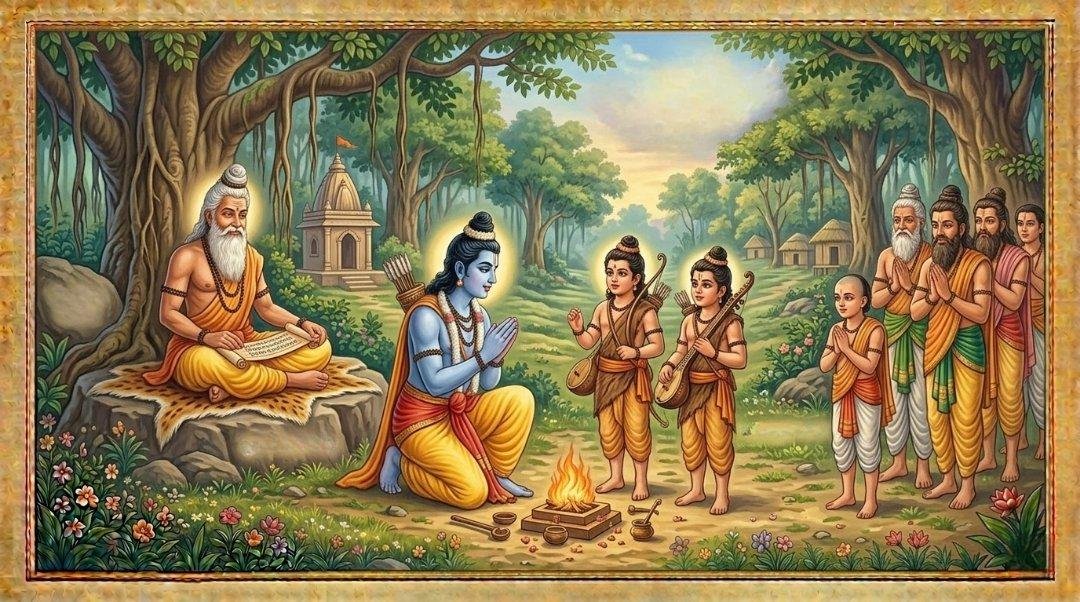
Lava and Kusha at Valmiki’s Ashram
Suggested image: traditional Indian artwork showing young Lava and Kusha with Sage Valmiki.
🌳 Sita Lives at Valmiki’s Ashram
The later Ramayana tells us that Sita eventually lives in the hermitage of Sage Valmiki.
Away from the royal palace, she raises her children.
The forest environment becomes the place where Lava and Kusha grow up.
They learn about life, discipline and the traditions of their time.
Most importantly, they learn the story of Rama.
👦 Who Are Lava and Kusha?
Lava and Kusha are traditionally presented as twin sons of Rama and Sita.
Although they are born into the royal family of Ayodhya, they grow up away from the palace.
They do not initially experience the privileges of royal life.
Instead, their childhood is closely connected with the hermitage and the teachings of Valmiki.
This makes their later meeting with Rama especially meaningful.
📜 Sage Valmiki Teaches the Boys
Valmiki becomes an important teacher in their lives.
The traditional narrative says that he teaches them the Ramayana.
Lava and Kusha learn to recite the epic with music and rhythm.
They become skilled performers.
But they do not yet fully understand how closely the story they are singing is connected to their own lives.


Valmiki Teaches Lava and Kusha
🎵 The Boys Learn to Sing the Ramayana
The Ramayana was traditionally transmitted through recitation.
In the story, Lava and Kusha learn to sing and recite the epic.
They travel and perform it before different audiences.
Their voices carry the story of Rama’s life:
Rama’s childhood
His marriage to Sita
The exile
The abduction of Sita
Hanuman’s journey
The war in Lanka
Ravana’s defeat
Rama’s return to Ayodhya
The remarkable part is that they are telling the story of their own father.
🏹 The Ashwamedha Yajna
Rama later performs the Ashwamedha Yajna, a major royal ritual described in the later tradition.
A specially designated horse is released.
The horse travels through different territories.
The traditional idea behind the ritual involves the authority of the king.
If another ruler stops the horse, a confrontation can follow.


The Ashwamedha Horse
🐎 Lava and Kusha Encounter the Horse
The traditional story describes the Ashwamedha horse reaching the area where Lava and Kusha live.
The boys stop the horse.
Rama’s forces are surprised.
The young boys are not ordinary children.
They have been trained in martial skills and are capable of defending themselves.
A confrontation follows.
⚔️ The Young Princes Show Their Strength
Several warriors are unable to defeat Lava and Kusha.
The story presents the boys as remarkably skilled.
Their identity is still unknown to Rama’s army.
The situation becomes increasingly serious.
Eventually, the truth begins to emerge.
🕉️ A Hidden Family Connection
The young warriors are not strangers.
They are Rama’s sons.
But Rama has not yet fully recognised them.
The situation becomes one of the most emotional episodes of the later Ramayana.
Two young boys have unknowingly challenged the army of their own father.


Lava and Kusha Face Rama’s Forces
🎵 The Ramayana Reaches Rama
Lava and Kusha eventually recite the Ramayana before Rama’s court.
Rama listens carefully.
He hears the story of his own life.
He is deeply moved by their performance.
But there is something extraordinary about the two young singers.
They know the story with remarkable detail.
Rama begins to understand the truth.
❤️ Rama Discovers His Sons
The traditional narrative reveals that Lava and Kusha are Rama’s sons.
The meeting is emotional.
Rama finally comes face to face with the children he had been separated from.
The story connects the past and present.
The sons have learned their father’s story.
Now they meet the father whose story they have been singing.


Rama Meets Lava and Kusha
🌺 What Happens to Sita?
The later story reaches its most emotional moment when Sita is called upon once again.
Sita has spent years away from Ayodhya.
She has raised Lava and Kusha.
She has endured separation from Rama.
Now she makes a final declaration of her truth and innocence.
🌍 Sita Returns to Mother Earth
According to the traditional narrative, Sita calls upon Bhumi Devi, Mother Earth.
She asks the Earth to receive her if she has remained faithful and innocent.
The Earth opens.
Sita is taken back into the Earth.
This is traditionally understood as Sita’s final departure from the earthly world.


Sita’s Final Departure
😢 A Painful Moment for Rama
Sita’s departure is deeply painful for Rama.
The king who has won a great war cannot prevent the loss of the person he loves.
The Ramayana repeatedly shows that victory and happiness are not always the same thing.
Rama has defeated Ravana.
He has returned to Ayodhya.
He has become king.
Yet he still experiences personal sorrow.
👦 Lava and Kusha Become Part of Ayodhya
After the revelation of their identity, Lava and Kusha become connected with the royal family of Ayodhya.
They continue the legacy of Rama and Sita.
Their story also represents the continuation of the Ramayana itself.
📖 Why Are Lava and Kusha Important?
Lava and Kusha are important not only because they are Rama’s sons.
They also have a special connection with the epic’s tradition of storytelling.
They become associated with the recitation of the Ramayana.
This creates a fascinating idea:
The Ramayana becomes a story that is passed from one generation to the next.


Lava and Kusha Recite the Ramayana
🌏 The Ramayana Lives Through Storytelling
For centuries, the Ramayana has been shared through:
- Storytelling
- Poetry
- Temple traditions
- Folk performances
- Dance
- Theatre
- Music
- Literature
- Television and cinema
Different communities have developed their own versions and interpretations.
That is why the Ramayana is not simply a book.
It is also a living cultural tradition.
🧘 Valmiki’s Role
Valmiki occupies a unique position in the traditional story.
He is presented as the sage who composed the Ramayana.
He also becomes an important protector and teacher for Sita and her children.
His role therefore connects:
The story
with
The people who preserve the story.
🌟 The Message of Lava and Kusha
The story of Lava and Kusha teaches several important ideas.
👨👦 Family
Even after long separation, family connections remain powerful.
📖 Knowledge
The boys learn through education and storytelling.
🎵 Tradition
The Ramayana survives because stories are passed from one generation to another.
🧭 Identity
Lava and Kusha discover who they are and where they come from.
❤️ Courage
They face powerful warriors despite being young.
🕉️ The Ramayana Is More Than a War Story
When people think about the Ramayana, they often remember:
Rama vs Ravana
Hanuman’s leap
Sita’s abduction
The bridge to Lanka
But the epic also contains stories about:
- Parents and children
- Brothers
- Kingship
- Friendship
- Loyalty
- Separation
- Sacrifice
- Forgiveness
- Responsibility
- The passing of traditions
Lava and Kusha bring many of these themes together.
🌟 Conclusion
Lava and Kusha grow up away from the royal palace under the care of Sita and the guidance of Valmiki.
They learn the Ramayana and become skilled reciters.
During the Ashwamedha episode, they encounter Rama’s forces.
Eventually, their true identity is revealed.
They are Rama and Sita’s sons.
Their story becomes one of the most emotional parts of the later Ramayana.
Sita’s final departure from the earthly world marks another major turning point.
And through Lava and Kusha, the story of Rama continues into the next generation.
Leave a Reply