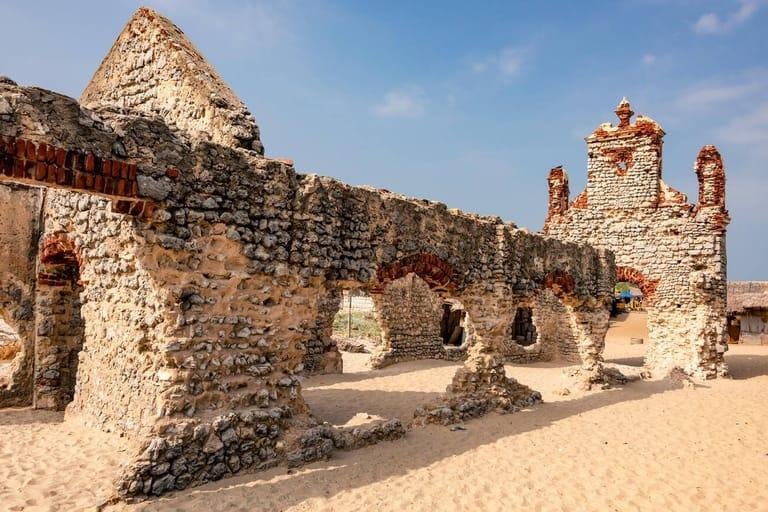
Imagine travelling to the southern tip of India and suddenly finding yourself surrounded by sea, sand, ruins and silence.
There are remains of old buildings.
A forgotten railway story.
A church standing among the ruins.
And a road that seems to disappear into the horizon.
This is Dhanushkodi, a remarkable place on Rameswaram Island in Tamil Nadu.
Today, it is famous as a hauntingly beautiful destination. But decades ago, it was a functioning town connected to India’s railway and maritime routes. The story of how that town disappeared is one of the most dramatic chapters in India’s coastal history.


🏘️ Dhanushkodi Was Once a Busy Town
It is difficult to imagine Dhanushkodi as a busy settlement when you see its ruins today.
Before the disaster of 1964, Dhanushkodi had important railway and maritime connections.
It served as a gateway for travel between India and Ceylon, now Sri Lanka. Railway services connected the area with the wider network, while ferry and steamer services connected Dhanushkodi with Talaimannar in Sri Lanka.
The town had facilities such as a railway station, post office, customs and port-related offices.
It was not simply an isolated village.
It was an important transport point between two countries.


🚂 The Railway That Connected India and Sri Lanka
One of the most fascinating parts of Dhanushkodi’s history is its railway connection.
Passengers could travel towards Dhanushkodi and then continue their journey by sea towards Sri Lanka.
The route formed part of an important India-Ceylon connection during the pre-1964 period.
For travellers of that era, Dhanushkodi was therefore much more than a beach destination.
It was a gateway.
🌪️ Then Came the Disaster of 1964
Everything changed in December 1964.
A powerful cyclone and huge waves struck the Rameswaram-Dhanushkodi region.
The destruction was enormous.
Buildings were damaged or swept away, railway infrastructure was destroyed and large areas of Dhanushkodi were devastated. The town was subsequently left largely uninhabited.


🚆 The Train Tragedy
Perhaps the most heartbreaking part of the disaster involved the Pamban-Dhanushkodi Passenger train.
On the night of December 22–23, 1964, the train was travelling towards Dhanushkodi during extremely dangerous weather.
A huge wave struck the train near Dhanushkodi.
The train was swept away, and everyone aboard was lost. Contemporary reporting based on railway records says the exact death toll is uncertain, with estimates varying; one railway safety account recorded around 100–110 passengers along with railway staff.
This tragedy remains one of the most unforgettable stories associated with Dhanushkodi.
A railway journey that was supposed to end at a station ended in the sea.
🌊 A Town Lost to the Sea
The cyclone did not merely damage Dhanushkodi.
It transformed the place completely.
The railway station, railway line, houses and other structures were destroyed.
The destruction was so severe that Dhanushkodi was not rebuilt as the town it once was. Government tourism and municipal sources today describe the area as largely uninhabited since the disaster.


⛪ The Ruins That Remain
Today, visitors can see remnants of the old settlement.
Among the most recognizable sights are the old church ruins and railway-related remains.
These structures are powerful reminders of what once existed here.
The official Incredible India tourism site specifically notes the dilapidated railway station and church as reminders of the 1964 cyclone.
Standing beside these ruins and looking at the sea makes the history feel remarkably real.
🌅 Where Two Seas Meet
Dhanushkodi is also famous for its extraordinary geographical setting.
At the tip of the island, the Bay of Bengal and the Indian Ocean meet around the Arichal Munai area. Government tourism information describes Dhanushkodi as being flanked by these waters.


This creates a dramatic landscape of:
- 🌊 Blue water
- 🏖️ Long beaches
- 🌴 Sparse vegetation
- 🏜️ Sand
- ☀️ Open skies
- 🏚️ Historic ruins
It is one of those landscapes that looks almost unreal.
🕉️ Dhanushkodi and the Ramayana
Dhanushkodi also has an important place in Hindu tradition.
According to religious tradition, the name is associated with Lord Rama’s bow, and the region is connected with stories surrounding the journey to Lanka.
The nearby Kothandaramaswamy Temple is also associated with the Ramayana tradition. Incredible India notes that the temple survived the 1964 cyclone and remains an important historical and religious site.
It is important to distinguish between religious tradition and historical evidence—the Ramayana associations are part of the region’s cultural and spiritual heritage.
🏝️ Dhanushkodi Today
The Dhanushkodi of today is very different from the town that existed before 1964.
Instead of a busy railway settlement, visitors encounter a destination known for:
history + ruins + beaches + spirituality + dramatic scenery.
Tourism has given the area a new identity.
People come to see the remains, experience the coastline and understand the story of the vanished town.


🧭 Why Is Dhanushkodi So Fascinating?
There are many beautiful beaches in India.
There are many historic towns.
There are many religious destinations.
But Dhanushkodi combines all three with a powerful disaster story.
You can stand on the same island where:
- 🚂 trains once carried passengers
- 🚢 ships connected India and Sri Lanka
- 🏘️ a town once flourished
- 🌪️ a devastating cyclone changed everything
- 🏚️ ruins remained behind
- 🌊 the sea became part of the town’s history
That combination makes Dhanushkodi unforgettable.
📸 A Photographer’s Dream
Dhanushkodi has become popular among travellers and photographers because of its unusual scenery.
The contrast is striking:
ancient-looking ruins against a bright blue sea.
empty roads against an enormous horizon.
old structures surrounded by sand.


The best photographs, however, should also remind us that these ruins are connected to a real human tragedy.
⚠️ Respect the Place
Dhanushkodi is beautiful, but visitors should remember its history.
The ruins are not simply photo backgrounds.
They are remnants of a town destroyed by a catastrophic natural disaster.
Visitors should follow local instructions, avoid dangerous areas and respect religious and historic sites.
Coastal weather can also change quickly, so travellers should check local conditions before visiting.
🤔 What Can Dhanushkodi Teach Us?
🌊 Nature Can Change Everything
Human settlements can disappear when confronted with extreme natural forces.
🚂 Infrastructure Has a Story
A railway line can represent much more than transportation—it can connect communities and countries.
🏚️ Ruins Preserve Memory
Even when buildings disappear, the remaining structures can keep history alive.
🇮🇳 History Exists Beyond Famous Monuments
India’s history isn’t limited to palaces and forts.
Sometimes it can be found in abandoned railway stations and coastal ruins.
❓ Frequently Asked Questions
Where is Dhanushkodi?
Dhanushkodi is located at the southeastern end of Rameswaram Island in Tamil Nadu.
Why is Dhanushkodi called a ghost town?
The former town was devastated by the 1964 cyclone and was subsequently left largely uninhabited.
What happened in Dhanushkodi in 1964?
A powerful cyclone and associated waves devastated the area, destroying much of the town and its railway infrastructure.
Is Dhanushkodi a tourist destination today?
Yes. It is visited for its beaches, ruins, scenery, cultural significance and historical connections.
What can visitors see there?
Visitors can see coastal landscapes, historic ruins, remnants of the old settlement and nearby religious sites.
🌟 Final Thoughts
Dhanushkodi is not simply a place where a town disappeared.
It is a place where history, nature and memory meet.
Once, trains arrived here.
Passengers crossed the sea towards Sri Lanka.
Families lived here.
Businesses operated here.
Then, in one terrible night, the sea and the storm changed everything.
Today, the ruins stand quietly beside the ocean.
The railway is gone.
The old town is gone.
But its story remains.
Dhanushkodi reminds us that sometimes the most powerful historical monuments are not grand buildings—they are the ruins that survived long enough to tell us what happened. 🌊🇮🇳

🇮🇳 MANA BHARATHAM
Stories, Facts & Wonders From India
🌐 Website: allpincodes.online
📖 Blog: MANA BHARATHAM
Know India. Explore India. Celebrate India. 🇮🇳
Leave a Reply